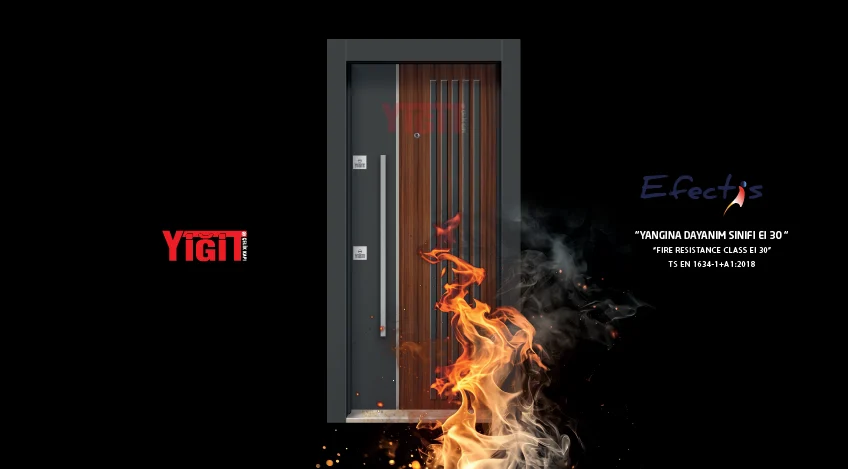
Fire is one of the greatest risks buildings can face. In Turkey, thousands of fires occur every year, and many fatalities result from inadequate safety measures. This is where fire-resistant steel doors matter. How do they differ from standard doors? Where are they mandatory? Let's look at the details.
What is a fire-resistant door?
Fire-resistant doors prevent the spread of fire and smoke for a specified period. They are made from materials that withstand high temperatures and are tested and certified accordingly.
The key difference from a standard steel door is that a fire door is tested and certified under defined standards that measure resistance duration, smoke control, and structural integrity.
Fire door standards and classification
In Turkey, fire doors are tested under TS EN 1634-1 and classified by resistance duration:
Contact Us
Request a quote for your project
Get information on production and installation of TSE-certified fire doors.
E (Etanchéité): prevents passage of flame and hot gases
I (Isolation): provides thermal insulation
Key features
1. Special materials
- Steel structure: galvanized steel at least 1.5 mm thick
- Fire insulation materials: mineral wool, vermiculite, or special boards
- Sealing system: intumescent seals that expand in heat
- Resistant coating: withstands high temperatures
2. Automatic closing system
- Mandatory hydraulic or spring closer
- Must always self-close
- Hold-open magnets can be linked to fire alarm
- Closing speed adjustable
3. Smoke sealing
Around 70% of fire fatalities are caused by smoke. Fire doors use special seals:
- Cold seals: tight fit under normal conditions
- Intumescent seals: expand to block smoke
- Threshold seal: prevents smoke from below
4. Panic hardware
- Panic bar
- Single-motion exit from inside
- Locked from outside, free from inside
- Integration with emergency lighting
Where are they mandatory?
Mandatory use areas
| Building type | Requirement | Minimum rating |
|---|---|---|
| Buildings 5+ floors | Stairwell entrance | EI 30 |
| Shopping centers | Fire compartment doors | EI 60 |
| Hospitals | All compartment doors | EI 60–90 |
| Schools | Stair and corridor doors | EI 30–60 |
| Hotels | Fire separation doors | EI 60 |
| Factories | Production area entrances | EI 60–120 |
| Enclosed parking | Building entrance | EI 60 |
Recommended areas
- Villas and luxury residences
- Basement floors
- Boiler rooms
- Electrical panel rooms
- Archives and storage areas
Testing and certification
Test stages
- Fire resistance test: exposure to high heat for the rated duration
- Smoke leakage test
- Heat transfer test
- Structural integrity test
- Automatic closing test
Required documentation
- TS EN 1634-1 test report
- CE certificate
- Fire performance certificate
- Factory quality certificate
- Installation and operation manual
What to consider when choosing
1. Correct resistance duration
Choose the EI class suited to building use and regulations. Longer is not always better if it adds cost without need.
2. Verify certifications
Request test reports and certificates. Fake certifications create legal problems.
3. Installation quality
Fire door performance depends on correct installation by a certified team.
4. Maintenance
Professional inspection at least twice a year is recommended.
Pricing and cost analysis
Fire door prices may be 30–100% higher than standard steel doors:
- Resistance duration: EI 30 < EI 60 < EI 90 < EI 120
- Size: larger doors cost more
- Special features: glass, design, smart lock
- Brand and quality
- Certifications
A fire door is an investment in life safety and legal compliance, and may reduce insurance premiums.
Installation
Before installation
- Check opening dimensions
- Inspect wall thickness and quality
- Plan electrical connections
- Fire alarm integration
During installation
- Precise frame fitting
- Full seal placement
- Closer adjustment
- Gap filling with fire-rated materials
After installation
- Opening and closing tests
- Seal inspection
- Closer adjustment
- Installation documentation
Periodic maintenance
Monthly check (user)
- Full closure
- Closer operation
- Lock condition
- Visible damage
Semi-annual maintenance
- Inspect and lubricate hinges
- Adjust closer
- Check seals
- Lock maintenance
Annual inspection
- Inspect all mechanisms
- Visual fire-resistance check
- Update certificates
- Maintenance report
Legal responsibilities
Building owner duties
- Use fire doors that meet regulations
- Periodic maintenance and inspection
- Keep certificates on file
- Maintain a fire safety plan
Penalties
- Administrative fines
- Facility closure
- Criminal liability in case of fire
- Insurance claim rejection
Frequently asked questions
Can a standard steel door be used as a fire door?
No. The door must be tested and certified.
How long does resistance last?
30, 60, 90, or 120 minutes by class, under approved test conditions.
Can it be kept open?
No. If it must stay open, use a magnet linked to the fire alarm.
How long is the certificate valid?
The certificate has no expiry date, but periodic maintenance is essential.
Is it mandatory in older buildings?
During renovation or change of use, fire safety measures must be updated.
Conclusion
Fire-resistant steel doors are not merely a legal obligation; they are a critical measure to protect lives. With the right choice, proper installation, and regular maintenance, they play a life-saving role.
The right time to act is before a fire occurs.
At Yiğit Çelik Kapı, we have produced fire-resistant doors since 2003. With TSE-certified production and accredited testing, we help secure your building's fire safety.
Yiğit Çelik Kapı
Fire-resistant steel doors
Contact our team for TSE-certified fire door models and technical support.